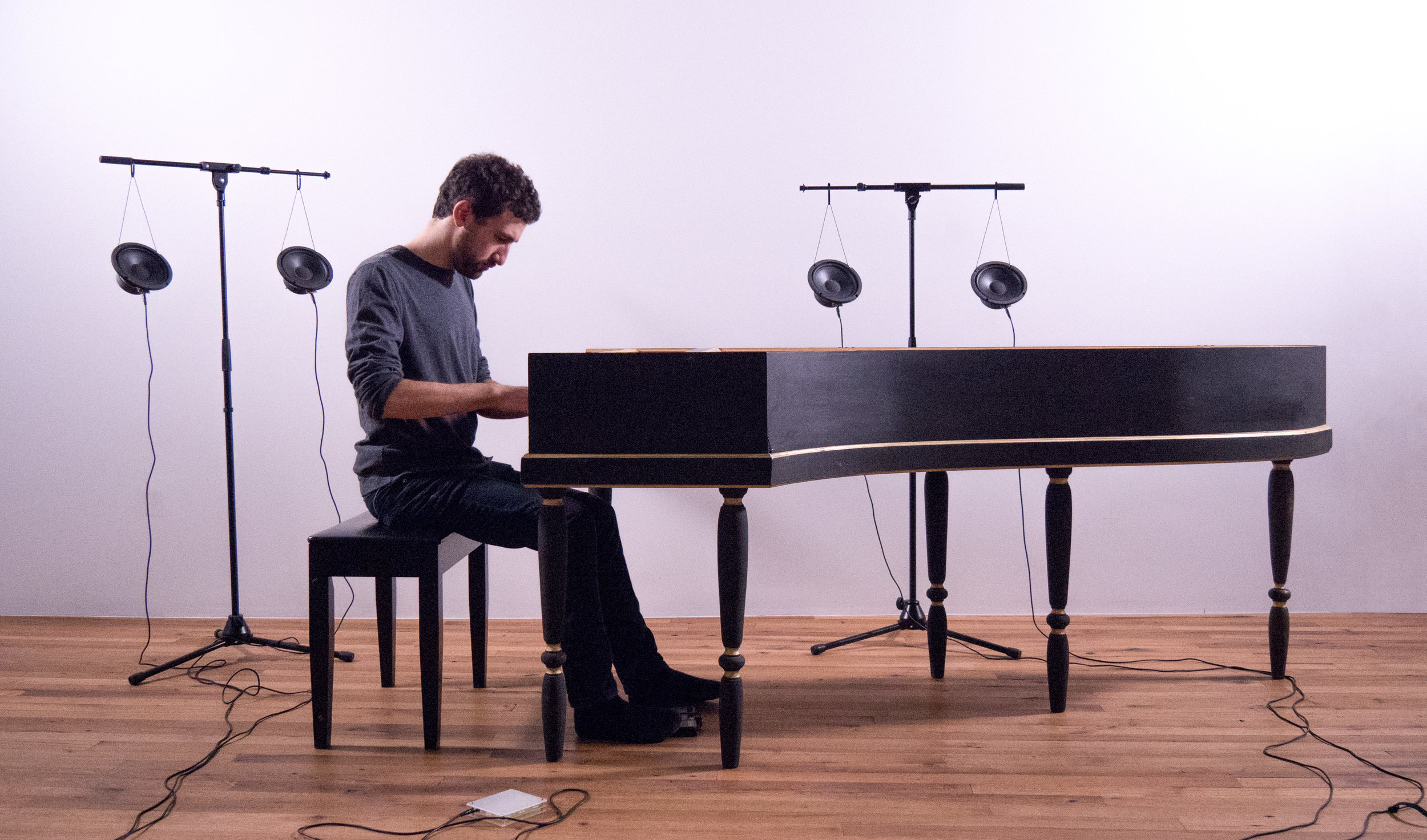
Tristan Perich, © 2015
Daniel Walden (b. 1989 in Berkeley, California) is a pianist, harpsichordist, music theorist, and musicologist. He is currently Assistant Professor in the Department of Music at Yale University.
As a researcher and academic, I focus on the global history of music theory, particularly in the nineteenth and twentieth centuries. I am interested in how musical thought shapes (and is shaped by) the politics of colonialism and resistance, as well as the role that media play in our evolving understanding of musical structures. In pursuing these interests, I draw regularly on my experiences as a pianist and harpsichordist, guided by the conviction that theoretical inquiry is deepened by connection with practical experience.
I am currently writing my first book, 1:1 : Natural Tuning, Keyboard Instruments, and the Commensuration of the Globe, which traces the emergence of just-intonation theories and practices from a global network of scholars, musicians, and instrument builders spanning Japan, India, Germany, Sierra Leone, and Mexico. I examine my experiences restoring, recreating and performing on historical just-intonation keyboards, and analyze how these instruments altered how musical nature and the politics of nationhood and identity were understood. Extracts of this work can be found in History of Humanities and a forthcoming article for the Journal of the American Musicological Society. I am also developing a second book project that examines the political ramifications behind two turning points in the nineteenth-century history of music theory: the introduction of probabilistic statistics and the development of the epistemological strategy that upheld musical parameters as separate and discrete. I will show how these developments drew on colonial logic and paved the way for the analytics of Big Tech corporations like Spotify, focused on harnessing massive reservoirs of musical data towards the generation of capital. My first forays into this topic appear in the Oxford Handbook of Timbre and Key Terms in Music Theory for Anti-Racist Scholars (forthcoming).
At the same time, I am working on several interrelated research projects. With Jonathan Service, I am completing a volume with translations of the German- and Japanese-language scholarship of the Meiji-era theorist Tanaka Shōhei, whose ideas also feature extensively in my book. With Nina Sun Eidsheim, J. Martin Daughtry, and Dylan Robinson, I am also assembling an edited volume focused on metaphors in music and sound, which will combine essays, creative writing, and graphic scores that explore the social, cultural, and political ramifications of metaphors about music. I have additionally obtained grants from the British Academy and Leverhulme Trust for my initiative New Instruments For Theory [NIFTY], focused on developing a suite of digital and DIY instruments for new directions in music-theoretical research and pedagogy. The first NIFTY instrument, a reconstruction of Tanaka’s just-intonation “enharmonium” that I designed in collaboration with instrument builder Georg Vogel, was completed in July 2023.
Prior to arriving in Yale, I was an Assistant Professor in Music Analysis at Durham University in the UK, and a Junior Research Fellow in Music at The Queen’s College (Oxford). I obtained my PhD in Music Theory from Harvard University as a Presidential Scholar, an MPhil in Music Studies from University of Cambridge (King’s College) as a Gates Scholar, and a BMus and B.A. in Piano Performance and Classics at Oberlin College and Conservatory.
For my Academia.edu profile and CV, please click here.
As a performer, I have earned praise for “extreme virtuosity” (Alex Ross, New Yorker) and “effortless elegance” (Mathew Guerrieri, NewMusicBox) in programs that blur the boundaries between historical and contemporary repertoire, as well as recital and improvisation. I am a graduate of Oberlin College and Conservatory, where I studied piano with Peter Takács and harpsichord with Webb Wiggins after completing private studies with Ann Schein, Sharon Mann, and Pierre-Laurent Aimard as a Cleveland Orchestra Artist-in-Residence Fellow in 20th- and 21st Century Music. I received early career support from the Leonore Annenberg Arts Fellowship for the Performing and Visual Arts for my projects aimed at broadening the keyboard repertory, and have appeared as a soloist and chamber musician at leading festivals and venues across the United States, Europe, and Asia. My first album, Dual Synthesis for harpsichord and electronics, was described as “one of the most outstanding recordings of new music in this century” (New York Classical Review) and profiled by the New York Times as one of "Five Harpsichord Works You Need to Know."
Highlights from the past few years include the premiere performances of Clara Iannotta’s Eclipse Plumage for prepared piano and ensemble (Gaudeamus Muziekweek, w/ Ensemble Oerknal; Arsenal de Metz w/ Ensemble Linea; London Contemporary Music Festival w/ Explore Ensemble); fortepiano recitals investigating Johanna Kinkel’s microtonal theories of Frédéric Chopin’s music, including on Lady John Scott’s Pleyel at the Cobbe Collection; the world premiere of Evan Williams’ Dead White Man Music for harpsichord and chamber orchestra with the Urban Playground Chamber Orchestra at St. Stephen’s (NYC), followed by repeat performances with members of the Toledo Symphony at Festival 4(19); and Julio Estrada’s complete yuuonhui’ cycle at the Mexican Cultural Institute in Washington DC (with Fonema Consort).
For a full artist bio, please contact me here.


